 Civilization Rights Institute
Dr. Ahmed Rashed Captivates ICOM Dubai 2025: Charting a New Future for Museums and Civilizational Sovereignty
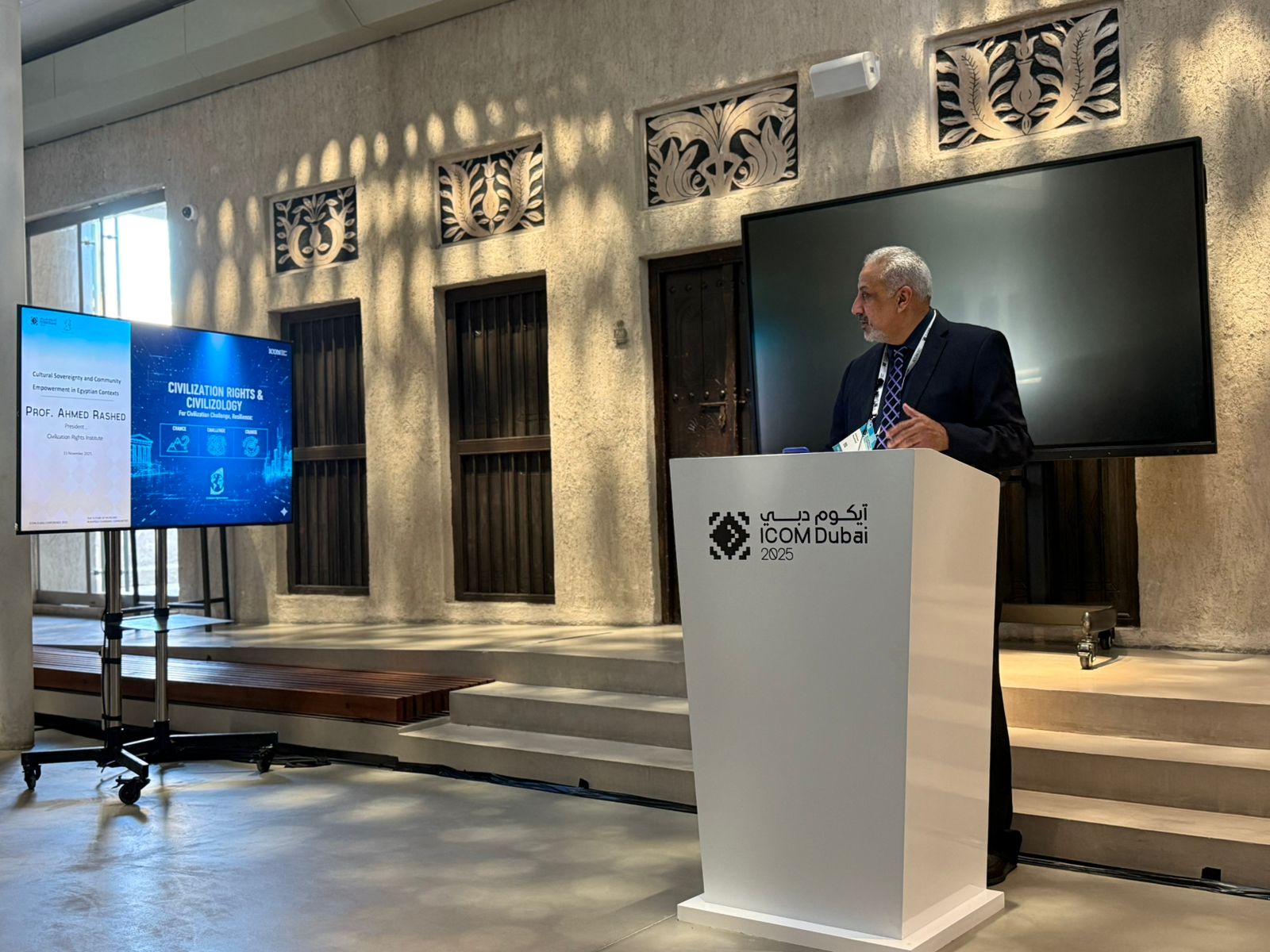
CRI President Dr. Ahmed Rashed Makes Talk of Dubai, Unveiling a New Era for Museums at ICOM Dubai 2025
Dubai, UAE – The Civilization Rights Institute (CRI) proudly announces the resounding success of its President, Prof. Ahmed Rashed, at the ICOM Dubai Conference 2025. Dr. Rashed’s compelling presentations, delivered amidst leading global museum professionals, policymakers, and academics, ignited crucial dialogues on cultural sovereignty, community empowerment, and the transformative potential of museums in a rapidly changing world.
Addressing the central theme, “The Future of Museums in Rapidly Changing Communities,” Dr. Rashed delivered a highly anticipated keynote address titled “Cultural Sovereignty and Community Empowerment in Egyptian Contexts” for ICME (International Committee for Museums and Collections of Ethnography) on November 15, 2025. This was complemented by a scientific paper presented earlier on November 13 for CIPEG (International Committee for Egyptology), “Mummies and Museology – A Civilization Rights Perspective.”
A Return to Purpose: From Al Ain to Al Shindagha
Reflecting on his journey, Dr. Rashed eloquently connected his foundational work at UAE University in Al Ain in 1998 – envisioning the UAE’s civilizational future – to his return to Dubai in 2025 as the Founding President of the Civilization Rights Institute. His address in Al Shindagha, a district he witnessed in its early transformation, underscored a profound continuity of purpose: to champion ethical stewardship, restore agency to communities, and safeguard their cultural heritage.
Unpacking the Civilization Rights Institute’s Transformative Vision
Dr. Rashed meticulously outlined CRI’s mission and its three foundational pillars, designed to protect heritage, promote justice, and power the global civilization rights movement:
- Principles: The Universal Declaration of Civilization Rights (UNDCR) – Foundational principles emphasizing the rights of all countries and nations to protect their ancient and modern civilization and claim rights from profit-generating entities.
- Framework: Civilizology – The scientific field tracing the roots of civilization rights and the processes (inputs) that generate civilization outcomes (outputs).
- Application: Civilization Resilience – The practical application of Civilizology principles to increase a civilization’s capacity to survive, adapt, and grow amidst shocks, ensuring cultures are not just preserved but alive, continuous, and resilient.
From Challenge to Chance to Change: A New Paradigm for Heritage
Part I: Confronting Colonial Legacies with the Universal Declaration of Civilization Rights (UNDCR)
Dr. Rashed highlighted the persistent challenges faced by ethnographic museums, including colonial histories, fragmented narratives, and disenfranchised communities. He asserted that existing legal frameworks are inadequate, often justifying the extraction and retention of cultural heritage. The UNDCR, with its 15 articles across three clusters—Protection, Identity & Knowledge, and Justice & Governance—establishes a binding framework elevating Civilization Rights to the same status as human rights, providing specific protections and restitution mechanisms.
Part II: The Chance – Civilizology in Action: From “What” to “How and Why”
Civilizology, as presented by Dr. Rashed, represents a profound shift from merely studying artifacts (outputs) to understanding the ‘engines’ (inputs and processes) that create civilizations. He showcased its power through:
- Ancient Egypt (The Great Pyramid): Unpacking the astronomy, mathematics, social organization, and engineering inputs behind this monumental output.
- Modern Dubai (Civilizational Governance): Demonstrating Dubai as an ongoing experiment in intentional civilizational design, balancing tradition and modernity with diversity as a key input.
- Future (Mars): Proposing the design of ethical civilizations on Mars, embedding Civilization Rights from day one to avoid Earth’s historical injustices.
Part III: The Change – Cultivating Civilization Resilience
By applying Civilizology, the CRI advances Civilization Resilience, enabling cultures to learn, adapt, and grow. This fusion of Civilization Rights and Civilizology ensures communities feel whole, proud, and engaged, fostering dynamic cultural continuity.
Egyptian Case Studies: A Playbook for Reclaiming Sovereignty
Dr. Rashed presented four compelling Egyptian case studies—the Rosetta Stone, the Bust of Nefertiti, the Dendera Zodiac, and the Luxor Obelisk—to demonstrate the practical application of Civilization Rights and Civilizology. He proposed creative solutions beyond mere physical repatriation, including:
- Joint stewardship models with rotating displays and shared interpretation.
- Digital reunification to restore context and meaning.
- Revenue and knowledge sharing to ensure equitable benefits.
- Collaborative storytelling that empowers source communities to control their narratives.
A Call to Action for Museums: What Must STOP and What Must START
Prof. Rashed issued a direct challenge to the global museum community:
What Museums Must STOP:
- Commodifying Heritage: Ending profit-driven exploitation without benefiting originating communities.
- Blocking Restitution: Resisting legitimate claims through legal technicalities.
- Controlling Narratives: Excluding source communities from interpreting their own heritage.
What Museums Must START:
- Implement UNDCR Principles: Integrating all 15 Articles into institutional policies and practices.
- Apply Civilizology Lens: Shifting from object display to revealing the systems and knowledge behind civilizational outputs.
- Partner in Resilience: Collaborating with source communities to strengthen cultural continuity.
- Build the Future Together: Co-creating exhibitions, sharing revenues, and empowering communities as equal partners.
The New Paradigm: Thriving Civilizations from Egypt to Mars
Dr. Rashed concluded by envisioning a new formula for museums and societies: Civilization Rights + Civilizology + Civilization Resilience = Thriving Civilizations. This paradigm sees museums become partners, not gatekeepers; communities reclaim agency, not just artifacts; and civilizations build resilience, not just memory. He painted a powerful civilizational arc, from Egypt’s ancient wisdom, through Dubai’s dynamic present, to Mars’ ethical future.
“Every civilization has the right to flourish. Every community deserves agency. Every museum can be part of the solution.”
The Civilization Rights Institute extends its gratitude to ICOM Dubai 2025 for providing a platform for these vital discussions. The time for transformation is now, and CRI stands ready to lead the charge in making museums beacons of justice and true partners in building a sustainable human future.
Civilization Rights Institute
Advancing the rights, science, and resilience of human civilizations.
